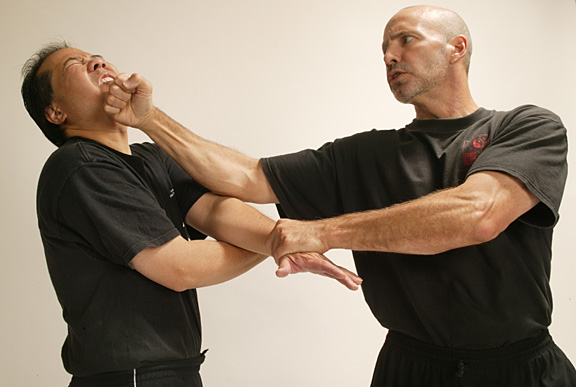
Picture this: You step onto the training floor, the air buzzing with focused energy.
It’s your first dive into the world of Wing Chun, a martial art that dances between tradition and efficiency.
As you embark on this journey, the spotlight turns to the heartbeat of Wing Chun – the 6 fundamental techniques.
From the rhythmic beats of “Chain Punches” to the solid foundation of the “Wing Chun Stance” and the meditative movements of “Sil Lim Tao,”
let’s unravel the 6 core techniques that form the very fabric of Wing Chun.
1. Chain Punches: The Drumbeat of Wing Chun
Imagine a rapid-fire burst of punches, each strike flowing seamlessly into the next – that’s the magic of “Chain Punches.”
This iconic technique is the drumbeat of Wing Chun, emphasizing speed, precision, and an unrelenting flow.
The beauty lies in its simplicity; no fancy wind-ups or elaborate movements, just a relentless barrage of straight punches.
As you delve into Wing Chun, mastering the art of Chain Punches becomes a rhythmic journey, connecting your body and mind in a harmonious dance.
2. The Wing Chun Stance: Your Rock-Solid Foundation:
The “Wing Chun Stance,” a posture that embodies stability and readiness.
This foundational stance is like the roots of a sturdy tree – providing a solid foundation for everything that follows.
With a slightly forward-leaning posture and knees flexed, the Wing Chun Stance allows for quick, controlled movements and easy weight shifts.
It’s the cornerstone of the art, grounding you as you navigate the intricate dance of Wing Chun techniques.
3. Sil Lim Tao: The Meditative Dance:
As you progress in your Wing Chun journey, you’ll encounter “Sil Lim Tao,” the first form that encapsulates the essence of the art.
See it as a meditative dance, a sequence of movements that might seem deceptively simple at first glance.
However, each motion is a brushstroke, painting a canvas of precise techniques and mindful transitions.
Sil Lim Tao is your introduction to the principles of structure, coordination, and focused energy – the building blocks of Wing Chun.
4. The Biu Tze (Darting Fingers) Principle:
As you advance, you’ll encounter the “Biu Tze” principle, often referred to as “Darting Fingers.”
This technique is like the unexpected twist in a compelling story. It involves quick, darting hand movements that catch your opponent off guard.
The Biu Tze principle teaches adaptability and the art of turning defense into offense, adding depth to your Wing Chun repertoire.
5. Pak Sao (Slapping Hand) Technique:
Imagine your opponent’s attack coming towards you, and with a swift motion, you redirect their force – that’s the essence of the “Pak Sao” technique.
Picture it as a redirection, a way to guide your opponent’s energy away from its intended target.
This technique embodies the Wing Chun philosophy of using minimal force to overcome a stronger opponent, showcasing the intelligence behind the art.
6. Quan Sao (Rotating Arm) Technique:
Quan Sao, or the “Rotating Arm” technique, is akin to a graceful dance move within the Wing Chun repertoire.
Arms rotating effortlessly, intercepting and controlling your opponent’s limbs.
It’s a dance of control and precision, highlighting the strategic brilliance embedded in Wing Chun techniques.
Final Thoughts
In conclusion, as you explore the 6 fundamental techniques of Wing Chun, envision it as a journey into a captivating dance.
The beats of Chain Punches, the rock-solid foundation of the Wing Chun Stance, the meditative flow of Sil Lim Tao, the surprising darting fingers of Biu Tze, the redirection of Pak Sao, and the graceful rotation of Quan Sao – each technique adds a layer to the beautiful tapestry of Wing Chun.
Embrace the rhythm, feel the pulse, and let the 6 fundamental techniques guide you in your martial arts odyssey.
Recommended Articles:


Leave a comment